
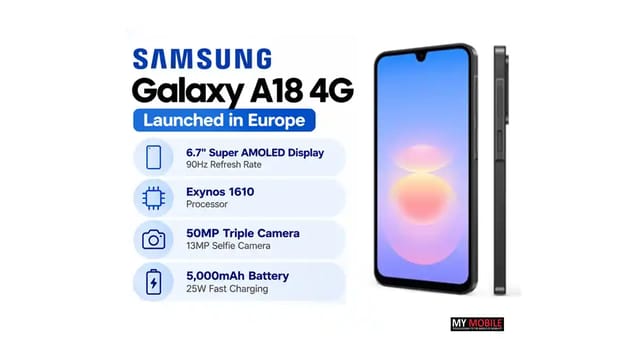
Samsung just dropped the Galaxy A18 4G and threw everyone for a loop. Back in August, the rumor mill had everyone convinced this phone would run a MediaTek Helio G99, the same chip powering the A15, A16, and A17. Nope. Samsung went ahead and slapped its own brand-new Exynos 1610 processor into it instead. We don't know much about this chipset yet, but Samsung's willingness to use its own silicon on a budget phone is pretty interesting.
Here's what you're actually getting. The A18 4G has a 6.7-inch Super AMOLED display running at 90Hz, which feels premium for this price range. It's got a flat frame with rounded edges, and Samsung threw in IP64 protection to keep dust and water splashes at bay. The design is solid, and it comes in Black, Grey, and Light Blue. Inside you'll find 4GB of RAM and 128GB of storage that you can expand up to 2TB with a microSD card. The whole thing weighs just 196 grams and measures 164.4 x 77.9 x 7.7mm.
The camera setup is actually decent for a budget phone. There's a triple rear setup with a 50MP main sensor, 5MP ultrawide, and 2MP macro lens. The 50MP camera has autofocus and can do 10x digital zoom, though there's no optical stabilization. On the front, you get a 13MP selfie camera with an f/2.0 aperture. Both cameras support video recording, and the rear can even do HD slow-motion at 120fps.
Battery life should be solid too. Samsung packed in a 5,000mAh battery with 25W fast charging, which supposedly gets you to 50 percent in 30 minutes. The phone runs One UI 9.0 based on Android 17, and here's the kicker: Samsung's offering six years of OS and security updates, which is genuinely impressive for a budget device.
The A18 4G also gets Galaxy AI perks like Circle to Search and Gemini integration, so you can control the phone with natural language commands. Pricing starts at €280 in France, NOK 3,290 in Norway, and SEK 3,290 in Sweden for the 256GB variant. There's no word yet on an India launch, but hopefully Samsung brings this one to our market soon because it's looking like solid value.
The real question now is whether that Exynos 1610 can actually keep up with the specs Samsung's thrown at it. We'll need to get our hands on one to see if the processor is a hidden gem or if Samsung should've stuck with MediaTek.